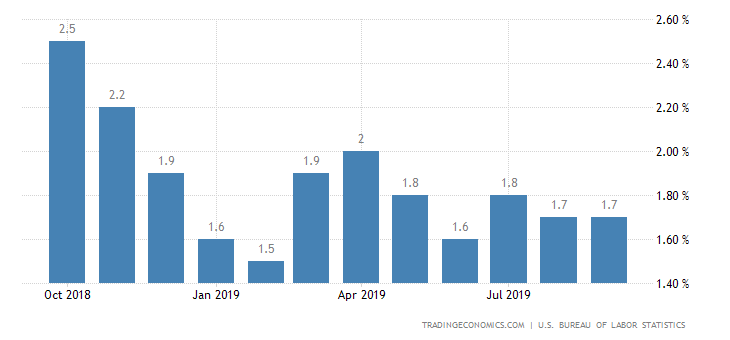
Food inflation edged up to 1.8 percent in September from 1.7 percent in August, as costs of food at home rose at a faster pace (0.6 percent vs 0.5 percent). Additional price increases were recorded for transportation services (0.8 percent vs 0.9 percent); medical care services (4.4 percent vs 4.3 percent); shelter (3.5 percent vs 3.4 percent); new vehicles (0.1 percent vs 0.2 percent); and used cars and trucks (2.6 percent vs 2.1 percent).
Energy prices tumbled 4.8 percent in September, following a 4.4 percent drop in the previous month. Within energy commodities, gasoline cost declined 8.2 percent (vs -7.1 percent in August) and fuel oil went down 8.5 percent (vs -8.4 percent in August). Within energy services, utility (piped) gas service cost slid 2.7 percent (vs -3.5 percent in August) and electricity prices rebounded 0.7 percent (vs -0.1 percent in August). Other declines were seen in prices of apparel (-0.3 percent vs 1.0 percent) and medical care commodities (-0.3 percent vs 0.1 percent).
The core inflation rate, which excludes volatile items such as food and energy, was also flat at one-year high of 2.4 percent, in line with market consensus.
On a monthly basis, consumer prices were unchanged in September, after a 0.1 percent gain in August and below market forecasts of 0.1 percent. Increases in shelter and food prices were offset by declines in energy and used cars and trucks costs.