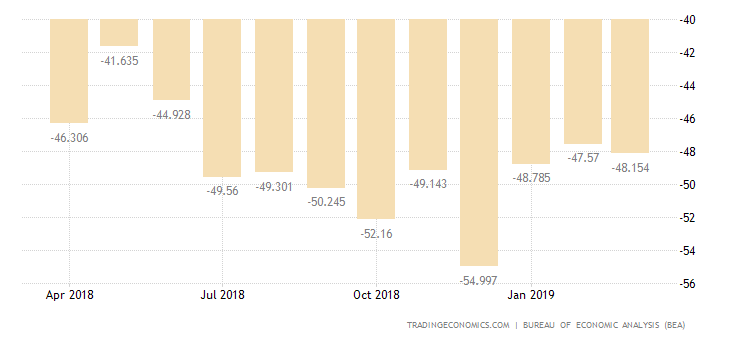
Exports from the US rose USD 2.3 billion from the previous month to USD 209.7 billion in February. Goods exports increased USD 2.1 billion to USD 139.5 billion, boosted by sales of civilian aircraft (up USD 2.2 billion), and automotive vehicles, parts, and engines (up USD 0.6 billion). By contrast, exports of industrial supplies and materials decreased USD 0.4 billion. In addition, exports of services, including transport and other business services, were up USD 0.2 billion to USD 70.1 billion in February.
On a non seasonally adjusted basis, exports rose to China (18.2 percent), Canada (2.1 percent) and the EU (2.5 percent), but fell to Japan (-13.9 percent), Mexico (-7.8 percent), Brazil (-13.1 percent) and OPEC (-3.3 percent).
Imports to the US increased USD 0.6 billion to USD 259.1 billion. Goods imports advanced USD 0.9 billion to USD 211.6 billion, as purchases of cell phones and other household goods rose USD 2.1 billion and those of other goods increased USD 0.5 billion. Meanwhile, imports of industrial supplies and materials fell USD 1.2 billion. Imports of services, such as transport and travel, declined USD 0.3 billion to USD 47.5 billion in February.
On a non seasonally adjusted basis, imports fell from all major trade partners: China (-20.2 percent), the EU (-4.6 percent), Japan (-1.2 percent), Canada (-0.6 percent), Mexico (-0.2 percent), Brazil (-13.3 percent) and OPEC (-33.7 percent).
The politically sensitive goods trade deficit with China decreased to USD 24.8 billion in February from USD 34.5 billion in January. The trade gap also narrowed with the EU (USD 9.2 billion from USD 11.7 billion) and Canada (USD 0.1 billion from USD 0.7 billion), but widened with Mexico (USD 7.4 billion from USD 5.8 billion) and Japan (USD 5.9 billion from USD 5.2 billion). With OPEC, the US posted a surplus of USD 0.4 billion, compared to a USD 1.3 billion deficit in the same month a year earlier.