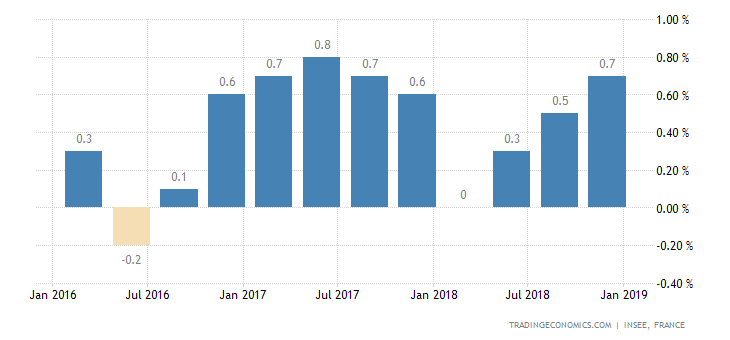
Net foreign trade contributed the most to the GDP growth (0.3 percentage points vs 0.2 p.p. previously estimated), followed by final domestic demand (0.2 p.p vs 0.1 p.p. previously estimated), while inventory changes subtracted 0.2 p.p. (vs 0.1 p.p. previously estimated). This negative contribution was mostly attributed to transport equipment.
Exports surged 2.3 percent in the fourth quarter (vs 0.2 percent in Q3), due to aeronautic and naval equipment deliveries, and imports increased at a softer 1.4 percent (vs -0.3 percent in Q3).
Within domestic demand, fixed investment rose 0.2 percent (vs 1 percent in Q3) as corporate investment growth slowed (0.2 percent vs 1.7 percent), notably because of the decline in businesses’ purchases of cars. In addition, household investment fell (-0.3 percent vs flat reading), particularly in housing. Meanwhile, government expenditure went up 0.4 percent, faster than a 0.2 percent rise recorded in the previous period.
Household consumption stalled in the fourth quarter, following a 0.4 percent advance in the previous three-month period as consumption of goods declined 0.6 percent (vs 0.3 percent in Q3), while consumption of services increased 0.5 percent (vs 0.3 percent in Q3). In particular, the strong downturn in engineered goods (-1.2 percent vs 0.5 percent) was linked to a decrease in automotive purchases following the surge in Q3. Expenditures on energy declined (-0.3 percent vs flat reading) due to low fuel consumption and temperatures higher than seasonal averages. Expenditure on food products remained broadly stable (-0.1 percent vs 0.1 percent).
Year-on-year, the economy advanced 0.9 percent in the fourth quarter of 2018, the weakest pace of expansion since the third quarter of 2016 and following a 1.3 percent growth in the previous three-month period.
Considering 2018 full year, the economy grew 1.5 percent, unrevised from earlier estimates and below the previous year's expansion of 2.3 percent. Growth slowed for household consumption (0.8 percent vs 1.1 percent in 2017), fixed investment (2.9 percent vs 4.7 percent), government spending (1 percent vs 1.4 percent), exports (3 percent vs 4.7 percent) and imports (1.2 percent vs 4.1 percent). On the other hand, inventory changes contributed negatively to the GDP growth.