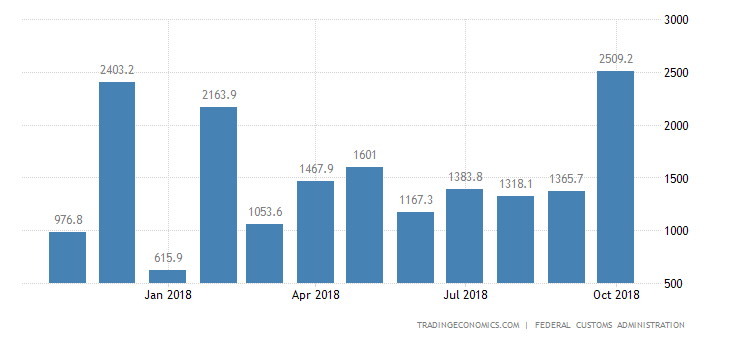
Exports increased 6 percent from a month earlier to a record CHF 18.86 billion in October, boosted by increases in sales of chemical and pharmaceutical products (11.5 percent), machinery and electronics (0.3 percent), watchmaking (4.2 percent), precision instruments (0.4 percent) and metals (0.4 percent). By contrast, exports of jewelry and bijouterie dropped 9.6 percent.
Among major trade partners, exports to the Euro Area rose 9.9 percent, mainly to Germany (3.8 percent), France (6.1 percent), the Netherlands (40.4 percent) and Spain (6.1 percent) while those to Italy declined 1.1 percent. In addition, sales increased to China (7 percent), Japan (1.8 percent) and the US (0.7 percent). By contrast, exports dropped to the UK (-9.7 percent) and Poland (-7.4 percent).
Imports declined 1.8 percent to CHF 16.22 billion in October, as purchases fell for chemical and pharmaceutical products (-10.6 percent), machinery and electronics (-1.2 percent) and vehicles (-1.7 percent). Meanwhile, imports increased for metals (3 percent), jewelry and bijouterie (7.9 percent), and textiles, clothing, footwear (3.5 percent).
Among major trade partners, imports from the Euro Area went down 1 percent, namely from Germany (-0.7 percent), Italy (-3.9 percent) and the Netherlands (-8 percent), while those from France and Spain rose 18.4 percent and 8.5 percent, respectively. Also, imports dropped from the US (-4.4 percent), but increased from China (11.7 percent), Japan (38.6 percent) and the UK (0.3 percent).
Considering January to October, the trade surplus narrowed sharply to CHF 14.39 billion from CHF 20.16 billion in the same period of 2017.